We’ve Repowered Our Visual Brand

[Originally published June 11, 2015]

We’re excited to announce that our new logo is ALIVE! James Goodchap of Goodchap Brand Identity developed our visual brand after a lot of careful listening and strategic thought. Fun was definitely something we wanted to convey. Local. Fresh. Community-based. And, of course, solar.

“The Repower team and I have a longstanding and rich history of working together, so there was already a high level of trust and an understanding of the caliber of thinkers with whom I was working. The brand visual identity had to be distinct, memorable. We were looking for something that had a level of energy and excitement and that reflected the sustainable technology at this pivotal time in our world, when we all must look after the planet. This project resonated with me. As a long-term bicycle commuter, I was thrilled to put my oar in the water and partner with Repower.”

—James Goodchap

Thank you, James!

Sunlight Feeds Yolo’s Hungry

[Originally published May 27, 2015]

In 2014, Repower had the pleasure of supporting more than 25 Yolo County nonprofits. Every time a Yolo County homeowner goes solar with us, we donate money to a local organization. You repower your home with sunlight and we help repower our community. What's not to love?

One of our favorite nonprofits is Yolo Food Bank. Yolo Food Bank feeds 17,000 households each month. This year, when you go solar with Repower, we will donate $500 to Yolo Food Bank in your name. That’s one meal a day for a year: Feed 1,500!

Here’s how we do it:

  1. We perform a no-cost solar analysis to review your PG&E bills and evaluate available roof space to help you determine if solar is a good investment for your home.

  2. We evaluate and explain multiple financing options, including programs with no up-front cash outlay, to help you choose the one that’s best for you.

  3. We manage the entire solar process—design, permitting, installation, and financing—for you.

RepowerYolo leverages the power of group purchasing. Combined with Yolo Food Bank's  buying power - through bulk and wholesale purchasing - Repower saves you $3,000-10,000 on your solar installation and the Food Bank stretches each dollar donated to equal $5.50 in food value. That means that your solar system will give Yolo Food Bank $2,750 worth of food to help wipe out hunger in our community. 

Understanding Net Energy Metering and Solar's Relationship with Public Utilities

[Originally published May 12, 2015]

We launched Repower--a community-focused, group purchase program to help our friends and neighbors in Yolo County go solar--18 months ago. After more than 40 residential solar installations, here are a some  observations from PG&E country:

Net Energy Metering (NEM). Net metering helps solar customers, especially when their usage is low in the spring and fall (less air conditioning and heating). In those months, customers bank their surplus energy production and use it to offset summer and winter usage.

ROR. Repower's 40+ installations generate an average of approximatley 6.5 kw--a bit higher than the state average--and customers get their money back in about 6 years, for a rate of return in the 12% range. I characterize solar as a bond investment, i.e., very low risk and steady returns for long periods of time.

Greater Personal Power. Our homeowners value and enjoy the feelings of independence and control that generating their own clean power gives them. Yes, they are tied to their utitlities through Net Energy Metering (NEM), but they are no longer subject to its rate hikes and complicated fee structures. 

Community Choice Aggregation Districts. The Investor Owned Utility's (IOU) general reluctance to change their business models to support locally-generated power is forcing many communities to consider setting up their own Community Choice Aggregation Districts, another poke-in-the-eye to IOUs.

One IOU's Approach. The Modesto Irrigation District, which serves a relatively large customer base in the Central Valley, generates its own power. Because its Net Energy Metering program has already reached capacity, it's no longer available. Instead, solar customers qualify for a new rate structure that lowers their rates across the board. Installing a solar system instantly reduces the total bill by more than 25%, without taking into account the value of the solar generated electricity. While better than nothing, Modesto Irrigation District's fix still falls short of the ROR that homeowners should be getting for the surplus electricity they generate.But, it's a start. 

A Big Game Changer ... Down the Line. On April 30, Tesla CEO Elon Musk revealed the new Tesla Energy battery for businesses and utility companies. Tesla's relatively inexpensive battery solutions for storing solar-generated electricity will be a game changer, but the extent of the transformation depends in part on the utilities developing favorable rate structures. The other major factor rests with battery development. Tesla's announced battery is intended for backup power supply, not for leveling usage. While Tesla's innovation is exciting, it will take years before it becomes pragmatic and adoptable for IOUs. 
 

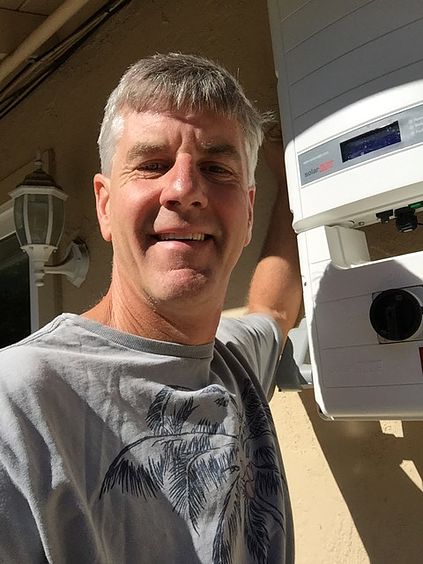
Solar Selfie of a Happy Repower Homeowner

[Originally published May 8, 2015]

When Jeff Tweddale moved from redwood country to sunny Davis, he went solar. Motivated by his general philosophy of energy conservation, Jeff said, "I never doubted it. There are so many options for how we go solar. Anybody who lives in a places that generates so much sunlight is stupid not to go solar." 

The thing that caused him to act so quickly was the hungry sound of his swimming pool pumps guzzling non-renewable electricity. It was wasteful. 

Jeff checked out a few companies, Sunpower and Solar City included. Why did he choose to go solar with Repower? Local owners and the local ownership model. He wanted to invest his money in the long-term of solar to own. With Repower, the solar energy system will stay with the house, if and when he sells it.  The economics of Repower's plan, plus his own personal commitment to energy conservation, sealed the deal.

And, now that he's generating his own electricity, he feels great. In Jeff's own words, going solar makes him feel:

"Excellent. Confident. Appropriate. Empowered."

The installation went "perfectly well and took only six weeks, from beginning to end. Repower gave excellent presale support, and Chris and John were very thorough." 

A Solar Story that Began with Love

[Originally published April 23, 2015]

Richard Kaiser fell in love. Then he moved to Davis to be with his darling and her children. They lived in her home and decided to remodel the inside. In the throes of renovation, Richard bumped into his friend and Repower homeowner, John Mott-Smith, who suggested they go solar with Repower.

"I never talked with anyone else. I'd trust John with my life. And I know that he never wastes money. I don't have a bone to pick with PG&E, but I liked the idea of making our own electricity and saving money. The economics seem to work out.

"Repower's solar energy system installation process was a lot quicker than I expected. It was painless, quick, sooner-than-later."

Repower is community-focused. Richard's story illustrates just how powerful friends and neighbors can be. And this is exactly what energizes our Repower team. 

Solar: No Longer Just for Idealists

[Originally published April 14, 2015]

The Idealist and the Pragmatist; two sides of the same behavioral coin. For idealists, repowering a home with solar creates a playground for exploration, discovery, bragging rights, and the “cool factor.” The idealists can afford to do the “right” thing. Pragmatists, while also excited about doing new things, are a bit more cautious. Decision-making is driven by doing the “smart” thing.

What does it take for solar to become commonplace? To shift from the “cool” thing to do, to the “smart” thing to do?

With any emerging, high-growth market, potential customers can be segmented into Idealists and Pragmatists, and few markets better exemplify this dichotomy than solar power. The idealists are the likes of James Tennant Baldwin, who in 1977, 138 years after the discovery of the photovoltaic effect, built the world’s first building to be completely powered by wind and solar energy. Idealists are visionaries like President Jimmy Carter, who installed solar panels on the white house in 1977 and created the first federal incentives for solar energy systems.

The answer to my question above, is time. For technologies to become ready for the mass market, it takes time. And that time, that shift, is now. When President Carter repowered the White House with solar, the systems cost in the area of $20/watt. Alternative energy sources used to be too cost prohibitive for the average homeowner, and were limited to wealthy environmentalists and early adopters, the “I’m cool, but I’m not mainstream” group; a fairly small demographic. The high cost was worth the “cool factor.”

Fast forward to today. In 2013, more solar was installed in California than the prior 30 years... Combined. And, in 2013, the average cost of residential solar systems in Yolo County was $4.90 per watt. Today, homeowners who take advantage of the RepowerYolo group discount are enjoying even more significant savings, purchasing solar for $3.30-$4.00/watt. Instead of paying PG&E every month, Yolo County homeowners are profiting from the sun, earning a 10-18% annual investment return while increasing the value of their homes.

What does this mean? It means that solar energy is no longer reserved for the idealists. Repowering a home is now affordable, feasible, and profitable for the average homeowner. And the best part about solar energy? It is now the smart thing to do, while remaining the right and cool thing to do. Solar power reduces or even eliminates your electric bill, it helps the environment, and it’s easy.

The key to successfully repowering your home is to understand and leverage opportunities. Community-centered programs like RepowerYolo help eliminate the guesswork, and assure the best possible price. When a community leverages its purchasing power, homeowners can secure an even greater price reduction than before.

So what is the breakdown? This is the year to repower your home. Solar is easy and affordable, it’s the right thing to do, it is the cool thing to do, and now, it is the smart thing to do.

Repower Homeowner Reaches Net Zero and Projects Surplus

[Originally published April 9, 2015]

We recently received this email from Repower homeowner, Fred Lee:

"Today is an important milestone in our solar cell operation in that the PGE smart meter today reads the same as the day we officially started operation of the solar cells on July 15, 2014.  This means that the solar cells have generated as much electricity as we have used since July 15, 2014. From now till next October we will be generating more electricity than we use and will be able to sell the excess to PGE next July on the one year anniversary of the solar cell operation. We expect to generate at least 50 kW/day over the summer and early fall. In a couple of months we will generate sufficient electricity to pay off the monthly cost of the loan that we took to pay for the solar cells."  

And there you have it, directly from one of our homeowners. Great news! We'd love to help you repower with solar. Just give us a call or submit your contact information.

California Poppies, Sandwiches and Solar Panels

[Originally published April 2, 2015]

California’s state flower, the California Poppy, aka Eschscholzia californica, is the perfect representative of our Golden State. It opens its petals to sunshine, closes them at night and on cloudy days. Sounds a lot like a solar energy, n’est-ce pas?

Equally enchanting is the photovoltaic cell. Photovoltaic meanschanging light into energy. (tweet this!) And when you link a lot of photovoltaic cells together, you’ve got a solar panel.

"Each photovoltaic cell is basically a sandwich made up of two slices of semiconducting material, usually silicon—the same stuff used in microelectronics.” (www.livescience.com)

Phosphorus and boron are added to this silicon sandwich to create an electric field. These photovoltaic cells allow particles of light, photons, to knock electrons free of the atoms in order to generate electricity. When a photon of sunshine knocks an electron free of its atom, the electric field created expels the electron out of the silicon junction. (All made possible by the application of Einstein’s Nobel Prize winning work on the photoelectric effect.) Metal conductive plates along the sides of this tiny energy-sandwich then collect the electrons and transfer them to the wires. Sun-generated electricity!

For a more detailed explanation of how solar panels work, check out How Do Solar Panels Work? at www.livescience.com. 

When going solar DOES NOT make sense

[Originally published April 1, 2015]

Most solar companies try to convince you that it is always a sound financial decision to go solar because, ahem,selling solar systems is how they make money.  The RepowerYolo Community Program is different. If going solar is not going to save you money on your PG&E bills or work with your roof or landscape, RepowerYolo will say so.  So ... in addition to bringing our friends and neighbors in Yolo County together to generate significant savings on their solar installations (through a group purchase discount), the RepowerYolo Community Program makes sure people get the facts straight-up, even if it means that going solar doesn't make sense for them.

For Example ....  

A Yolo county homeowner came to us for a free analysis of her home for solar. After looking at her historical PG&E bills, the fixed costs of installing a system (permits and engineering fees, for example) in relation to the energy that would be generated, and the age of her roof, it was clear that the expense of going solar would take too long to recoup in savings on her electricity bills.


Already Super Energy-Efficient

The economics of going solar weren’t great for this particular homeowner because she was already environmentally frugal—the money she spent on a solar energy system would require nearly two decades to recover because of her low electricity use.


Older Roof

In addition, her roof will need replacing soon and it was hard to justify installing solar panels that would need to be removed and reinstalled when she replaced her roof. Installing solar panels at this point would have upped her cost of producing her own energy.


Smaller System

The homeowner’s fixed costs on the small system she needed would be spread out across so few panels that the system costs per unit would be high … too high.


Yes or No, Our Approach Remains the Same

This homeowner asked great questions. Even after RepowerYolo advised her that going solar did not pencil, given the above factors, we invited her to call any time. Conversations are no pressure and transparent. Whether or not you choose to become a RepowerYolo homeowner, we will be accessible and responsive to you. If you do go solar via the RepowerYolo Community Program, we will be as available to you after your solar energy system installation as we were before and during.

Cool Davis Announces Partnership with RepowerYolo

[Originally published March 19, 2015]

Nearly one year ago (April 28, 2014), Cool Davis announced our partnership. We couldn't have been more pleased to team up with such a worthy initiative!  In fact, since last year, Cool Davis and Repower have come together in many ways. For example, Cool Davis has an office within the Repower office. Chris Soderquist serves on Cool Davis's Board of Directors, while John Walter helps design and oversee Cool Davis's events. 

From the Davis Enterprise: Repowering Yolo County with the sun’s energy

[Originally posted March 19, 2015]

Thanks to Davis Enterprise reporter Felicia Alvarez for her profile of RepowerYolo: 

How do you get 1,000 homeowners to go solar?

This is the question that Chris Soderquist, co-owner of RepowerYolo, asked himself when he started a new solar company in Davis in 2013. An environmental activist and clean energy businessman, Soderquist launched RepowerYolo alongside John Walter to support homeowners in making Davis a clean-energy city.

After seeing friends and neighbors attempt to add solar power to their homes, only to end up with low guarantees and high prices, Soderquist and Walter took matters into their own hands and founded RepowerYolo.

The company uses group purchasing to reduce the cost of installing solar panels on homes and businesses. Instead of purchasing solar units individually, group-purchasing power allows a single homeowner to buy solar panels at the bulk price, the same price per unit as if 100 units were purchased at once.

RepowerYolo works as a project manager alongside solar contractors. The company, in turn, helps ensure that homeowners are getting the exact unit they need and are able to finance it in a way that works best for them.

Fred Lee, an El Macero homeowner, went solar through RepowerYolo last June.

Lee recalled receiving “massive” PG&E bills every July and December, amounting to $800 to $1,000 a month. With their two sons away at college, Lee and his wife turned toward solar to reduce their energy costs.

Today, 40 solar panels, each generating 270 kilowatts, cover his rooftop and provide more energy than his home uses, producing up to 450 kilowatt hours of energy. Using a 4-percent interest loan from Yolo Federal Credit Union, the Lee family purchased the panels for $40,000; they’re expected to be paid off within seven years.

Lee’s $800 monthly PG&E bill plummeted to $30 after the addition of the solar panels.

“If you analyze the situation, you can really cut back on electricity and gas,” Lee said, marveling at the difference made by moving away from the 8kwh electric heater that once warmed his home.

Two concurrent trends — PG&E’s rising rates and improvements in solar technology — have made solar power more accessible to homeowners, Soderquist explained.

In 2013, solar power dropped from $4 per watt to $1 per watt. The technology only continues to improve as more homeowners become interested in solar.

Meanwhile PG&E’s rates have risen from 10 cents per kwh to 16.5 cents per kwh over the past seven years. Rates are expected to continue to increase over the next few years, according to Soderquist.

Money isn’t the only thing on consumers’ minds, however.

“We have homeowners in their 60s and 70s that feel like it’s the right thing to do,” Soderquist said, “They feel that it’s right for their grandkids, good for the environment … and good for their planet.”

How to pay for it

RepowerYolo uses several different financing methods, including PACE (Property Assessed Clean Energy) financing, Yolo Federal Credit Union loans, home equity lines of credit and cash.

About 15 percent of Repower’s customers use PACE, 25 percent use credit union loans, 25 percent use home equity lines of credit, and the remaining 35 percent pay with cash, according to Charles Soderquist.

PACE financing gives homeowners the option of purchasing solar power panels and other improvements such as drip irrigation and insulation through no-money down payments that are added to a homeowner’s property tax bill. The taxes are collected over a 20-year period at 8 percent interest.

The Yolo Federal Credit Union also offers loans for solar installation and home equity lines of credit that can cover all of the costs of adding solar to a home, if a homeowner is eligible.
Top 5 Reasons Yolo County Homeowners Go Solar

[Originally posted March 18, 2015]

We’ve had the fortune of discussing solar with several hundred homeowners and community members. Some of the conversations are cursory — quick chats at The Farmers Market or at a coffee shop (we love Mishkas) — while others are more in-depth. No matter the rigour of the dialogue, we always ask the same question: Why Solar?

Yes, it is a very open-ended, extemporaneous question, but we often receive similar responses. Here are the top 5 reasons why Davis homeowners want to, and decide to, go solar.


1. I’m sick of PG&E and I want to slash my electrical bill.

Bingo. The primary motivation. A quick anecdote from a conversation last week: Why should I write a check to PG&E every month when I can generate electricity from a free (the sun) resource? RepowerYolo homeowners are saving, on average, $265 per month in PG&E electricity costs.
 

2. The cost of solar has gone down, but PG&E bills keep going up.

Correct and correct. The average cost of electricity for RepowerYolo homeowners, prior to installing solar, is approximately 23 cents per kilowatt hour; with solar, the amortized cost of solar electricity is between 8 and 11 cents/kilowatt hour. And, while PG&E rates will continue to rise, your cost of solar electricity will stay fixed.
 

3. I want to make sure the timing is right and I’m getting a good deal.

Most people do not want to be first (or be an “early adopter”). Fortunately, solar technology has matured considerably and the confluence of reduced solar costs and increased PG&E costs addresses the timing question. In terms of a good deal, of course, everyone wants to make sure they’re getting one. With RepowerYolo, homeowners are saving an average of $5,300 through their community group purchase discount (compared to the average cost of solar in 2013).


4. The planet is warming; I want to do my part. It’s the right thing to do.

Last week we discussed the behavioral pivot from idealists to pragmatists. Now that solar electricity is less expensive than PG&E electricity, what used to be a nice-to-have, icing-on-the-cake virtue of solar — environmental benefits — has become a primary motivator for idealists and pragmatists alike. Quick stats on the average RepowerYolo home:

- Eliminates 175 metric tons of carbon dioxide from the atmosphere.

- Equal to eliminating 36 cars’ annual emissions

- Represents 4,500 tree seedlings grown for 10 years
 

5. My neighbor has solar, and I think it is cool!

Studies have shown homeowners are twice as likely to go solar if a neighbor on their street has also gone solar. We are seeing this “neighborhood effect” in Davis … if my neighbor, who I know/trust, did it, then I should consider it too.

The Freedom and Security of Solar

[Originally posted March 4, 2015]

Recently, we were talking with a friend about PG&E and she expressed that she hated feeling at the mercy of PG&E's rate hikes, ambiguity, and complex pricing criteria. She said she despises being subject to the energy monopoly and wished she could go solar and be free of PG&E.

“I think homeowners who go solar have a streak of independence. They want choices. They refuse PG&E’s ‘It’s our way or the highway’ attitude. And I also think they are people who are smart and grow their money, rather than spend every last drop.”

She assured us that being at the mercy of 'the grid' has been bothering her for years. She expressed that it's terrible to feel optionless ... and to be governed by rules in which one has no say, especially after she has seen the big savings of Repower homeowners.


PAWs and UAWs

She also made an interesting connection to RepowerYolo homeowners and the profile of millionaires described in Dr. Thomas J. Stanley's book, The Millionaire Next Door, in which the author profiles PAWs or "Prodigious Acquirers of Wealth"—frugal, smart, and the antitheses of those opulent Lifestyles of the Rich and Famous—versus UAWs or "Underachievers of Wealth" who max out their spending rather than grow their wealth. 

All said, the primary motivation to go solar typically is not because it's good for the environment. Homeowners go solar because it's a sound financial decision. That solar is clean energy is just an added bonus. 


Simple, Smart Solar

We like things to be simple, smart, fast and direct. We've sorted through all the solar pitches and complexity, distilled the process down to excellent solar panels, installers, and financing options. And we've negotiated a group purchase discount that makes solar an even better investment. 

If you're a PAW who has that streak of independence that makes you want to be free of PG&E and reduce your overhead by producing your own electricity, please call to learn if you qualify for the Repower group discount:  (530) 564-4292.